Welcome to Mistik Acres.

We hope you are able to form a connection with us, and the products we grow and produce on the land we live and work with.

Showing posts with label seedlings. Show all posts

Thursday, March 19, 2015

The magic begins!


A glimpse into what is greening up.


Dahlia tubers I overwintered in wood shavings.


Most of them did great.  No drying out or rotting.


 Placed in crates and lightly covered with soil.


Waiting for them to show new shoots and then will pot them up.


Seedlings happy under the grow lights.


Have had great success with rooting scented geranium cuttings.


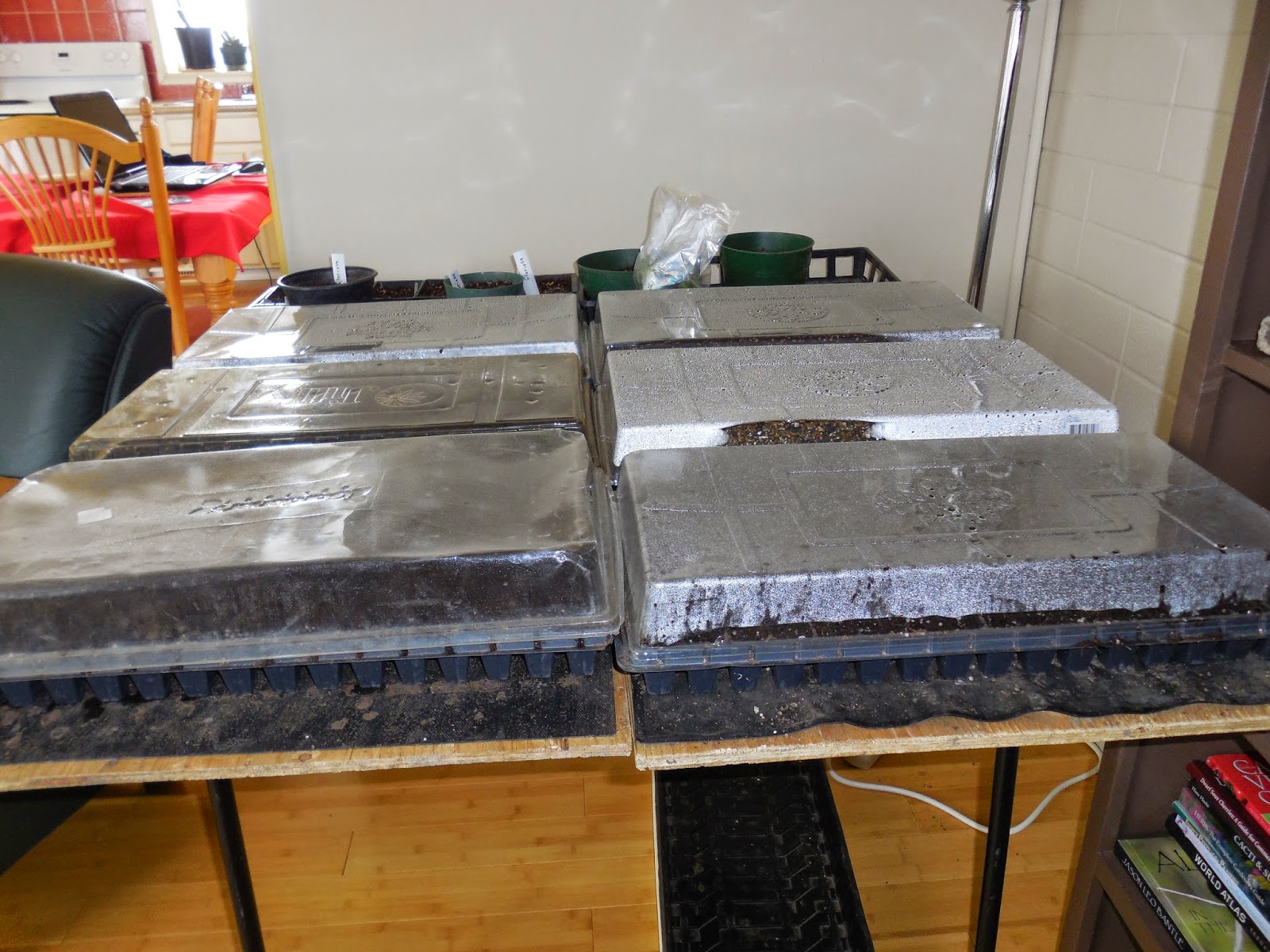
The heat mats will be full of seeded trays till mid May.

Monday, March 24, 2014

Happy Spring!


It feels a little more like Christmas here today than Spring.  For a couple of reasons, one being that the wind is howling and very cold today, and second we received another of our plant/tuber/bulb orders today.  So much fun opening the boxes and checking everything out.  We have one more box from this order yet to come.  Seems it was separated from the rest of the order.


Ice Cube Dahlia's


More Dahlias and Ranunculus


Lily bulbs and Dahlia tubers


Gloriosa Lily tubers and Wizard of Oz Dahlia's

The order also consisted of three different types of grasses along with Ranunculus corms and Achillea roots.
We have been busy the last few weeks, seeding and caring for the young seedlings.


Leonitis plants.  These are growing rapidly and had to pinch them way back to get them to slow down a bit.  New plant for us this year and looks like I started them much too early.


Stock seedlings are doing great.  Two new varieties I am trying.


Jasmine vine.  Another new plant for us this year.


Dahlia tubers sprouting.

Busy times ahead.

Sunday, March 25, 2012

Mason Bee Houses.

As time is going by, more and more seedling trays are being planted.  We have pepper's, leeks and celery in the vegetable category and many varieties of flowers and herbs growing at this time.  The perennials, rhubarb, and dahlia's are coming along nicely.  
We are busy getting ready for Gardenscape, taking place in Saskatoon March 30, 31 and April 1.  The following photos are houses for Mason Bee's, which we will have available to purchase at Gardenscape.  A Mason Bee is a solitary bee that lays it eggs in tubular cavities.  It is 70% more efficient at pollinating than a Honey Bee.  The Orchard Mason Bee appears black but is actually dark metallic green/blue in color. The female is approximately 14 mm in length, robust in appearance resembling a black fly. The male is smaller and more slender, and about 11-12 mm in length. Males are characterized by their long antennae and a tuft of light colored hair in the front of the head. At rest, the bee has its wings flush with its body. Osmia bees are effective pollinators because of their pubescence or hairiness. This enables them to carry pollen grains from flower to flower, causing pollination to take place. 

Mason Bee houses available in Cedar or natural Poplar.

The female Mason bee lives for about one month in the spring and she can produce one or two eggs a day. One tubular nest contain 7 - 11 cells where those laid first, in the back of the tube will develop into females while the few cells nearest to the entrance will be males.  When sufficient food has been deposited an egg is laid and the cell is sealed with a thin mud plug. The whole process is repeated for each egg and cell she creates until the tube is filled close to its entrance. Often the last cell is left empty to discourage predators. The tube is then closed with a thick mud plug at the entrance.  
A few days after the egg has been laid, the larva will hatch and will start feeding on the nectar and pollen reserves. The larva grows very rapidly and after 10 - 14 days most food reserves have been consumed. The larva will spin a cocoon and pupate. Later in the summer, the pupa will develop into an adult and will stay in the cell throughout the winter.
In early spring when the first warm days occur, male Mason Bees will first emerge. They chew their way through the mud plug with their strong mandibles. The males will stay near the tubular nests and wait for females to emerge. As soon as females appear, the males will attempt to mate. There is fierce competition between males and sometimes, a female is covered by a number of struggling males.

Closeup of the holes we drilled in the cedar wood blocks and the natural poplar logs for the Mason Bees.

Mason or Osmia Bees need access to mud. If a source is readily available near the nests, the females can be spared a great deal of time and labor. A patch of soil can be kept moist or a small bucket or tray can be filled with wetted soil.  Face nesting blocks as close to the southeast direction as possible to catch morning sun and affix it firmly so that it does not sway in the wind. It should be located at least three feet above the ground. 

The Orchard Mason Bee

Sunday, February 26, 2012

Seeding underway.

The seedlings are starting to appear, a few days after they were planted.  We will be continuously seeding as the weeks go by.  We sort our seed packages into groups of time frames.  Some seeds need to be started 8-10 weeks before planting, some 6-8 weeks, some 2 weeks and so on.  By sorting the packages, all seeds are started at the time intervals that are needed for transplanting into the gardens.
Castor Beans (my favorite)

 Hydrangea a. Invincibelle Spirit

The picture above is a new Hydrangea we will be offering for Spring sales.  It is hardy and as adaptable as the Annabelle, but produces loads of hot pink flowers from early summer to frost.  Dark pink buds open to hot pink flowers which then turn soft pink as they mature, finally changing to green at the end of their life cycle.  Deadheading not necessary.  Grows to 36-48" and spreads 36-48" with a mounding habit.  Blooms on new wood and requires full to part sun.  Hardy to Zone 3 and is an excellent cut flower.  May be pruned back in late winter to encourage strong new growth and blooming.  Adaptable to most, moist well drained soils.  Bloom colour is not affected by soil pH.

Rosa 'ChewperAdventure'  

The picture above is called Mango Salsa from the Oso Easy Series, another shrub available at the Saskatoon Farmer's Market in May.  The Oso Easy Series of roses are the results of years of searching and testing to produce a rose that grows like any other shrub and doesn't require any pesticides to keep it in prime condition.  These new developments bring disease and pest resistance together with great cold hardiness to provide the perfect rose for the Prairies.  The blooms are shades of ruby red grapefruit and summer sunsets.  They bloom on new wood starting mid summer and continue into fall.  The plant height is 24-36" tall with a mounded habit.  They require full sun and average water needs.  Hardy to Zone 3. 

Tuesday, April 5, 2011

Springtime.

Another week has passed since our last post and a lot has been going on out here.  The sun has been shining and the weather has warmed and the snow is melting at a fairly rapid pace.  There is still a lot of snow to melt but every day we are seeing more and more brown.
We have been busy planting, planting and more planting.  We received one of our stock orders this week with all the dahlia tubers.  It took a couple of days to get them all planted, but they are nestled in the warm garage busy sending shoots up out of the dirt.  We will have nine different colours this year, some new varieties and some old favourites.  Will go into more detail about those at a later post.
We seeded all the tomatoes yesterday.  Will have a couple of new varieties this year along with the reliable favourites.  We decided to plant some varieties that mature early, as the threat of the late blight may be a problem again.  The varieties we will have available for spring planting are:
Lemon Boy - low acid, producing yellow fruit, matures in 50 days
Bush Early Girl - compact plants with large fruit, matures 54 days
Prairie Pride - abundant, flavourful, medium sized fruit on sturdy compact plants, developed at the University of Manitoba, matures 55 days.
Tumbler - produces loads of 2" fruit, great for planting in pots, matures 60 days.
Cherry Sunsugar - unique golden colour, producing lots of cherry sized, very sweet fruit, matures 60 days.  Tried this tomato for the first time last year and we love it.
Mama Mia - meatier, firmer fleshed, great for salsa, and sauce, matures 60 days.
Bush Beefstake - heirloom variety, produces lots of 8oz fruit on a compact bushy plant, matures 62 days.
Big Beef Hybrid - our all time favourite, old-time flavour, good fruit size and very heavy yielding, staking variety, matures 70 days.
Roma- bush plant, paste variety, great for salsa and sauce, matures 80 days.
If you are interested in a particular variety, please let us know and we can set them aside for you, as some varieties will be in short supply.  If you experienced blight on your tomato plants last year, plant your tomatoes in another location in your garden, this growing season.
The celery seedlings are doing great.  Have never planted them before so really looking forward to observing them grow this year and harvesting the crop.  Garden grown celery has a strong wonderful flavour unlike anything you buy in the grocery store.

This month we started to consign our hypertufa planters at The Willow Studio downtown.  The address is 148 2nd Ave. N.  They have them on display with their outdoor garden furniture.  If you have never visited their store, I highly recommend to take the time to stop in.  They carry a lot of unique products you won't find elsewhere, to decorate your home inside and out.
Happy Spring!